


 Training Overview
See a summary of all our training options one page. All courses are currently available online.
 Group Training
The leader in business continuity education and certification across many industries, DRI International offers team training designed to fit the needs of every organization, from private corporations to the public sector and everywhere in-between.
 Higher Education
DRI International offers colleges and universities the opportunity to familiarize their students with information on business continuity professions and certifications recognized by private and public sector organizations around the world.
Certification Overview
Certification is a two-part process; verification of knowledge and confirmation of experience.
 Value of Certification
A DRI International certification is the most widely recognized and respected business continuity certification in the world. DRI only certifies professionals that have demonstrated both knowledge and experience in the business continuity and/or disaster recovery profession.
 Digital Badge Program
Learn more about how to unlock your DRI digital badge and display your DRI certification to enhance your online professional profile today.
 Maintain Certification
Maintaining your DRI International certification carries two requirements; an annual maintenance fee as well as Continuing Education Activity Points (CEAP).

Be a part of the premier business continuity conference.
Save the date for DRI2027 in Arlington, Texas Feb. 21-24, 2027. Check back for more information.
 Meet DRI
We speak at numerous industry events around the globe and engage with our community in a variety of ways. Find out where you can meet DRI.
 Thought Leadership
Through committees and other initiatives, we publish research and insights about the profession. Explore our library and other resources.
 Webinars
DRI International webinars cover vital resilience issues, engaging and informing professionals in the field. See what's coming up next and view previously broadcast presentations here.
 Hiring Guide
Learn how to hire the right business continuity professionals that will enable your organization to withstand any crisis and come through even stronger with the DRI Hiring Guide. Download now.
 What is Business Continuity Management (BCM)?
BCM is a holistic management process that identifies potential threats to an organization and the impacts to business operations those threats, if realized, might cause, and which provides a framework for building organizational resilience.
 DRI in the News
We reach out and engage as many audiences as possible using broad media coverage to provide a forum for discussion. We serve as a trusted resource to other professions and the general public.


Motiva receives DRI International Resilient Enterprise Award and ISO 22301 and REAP certifications
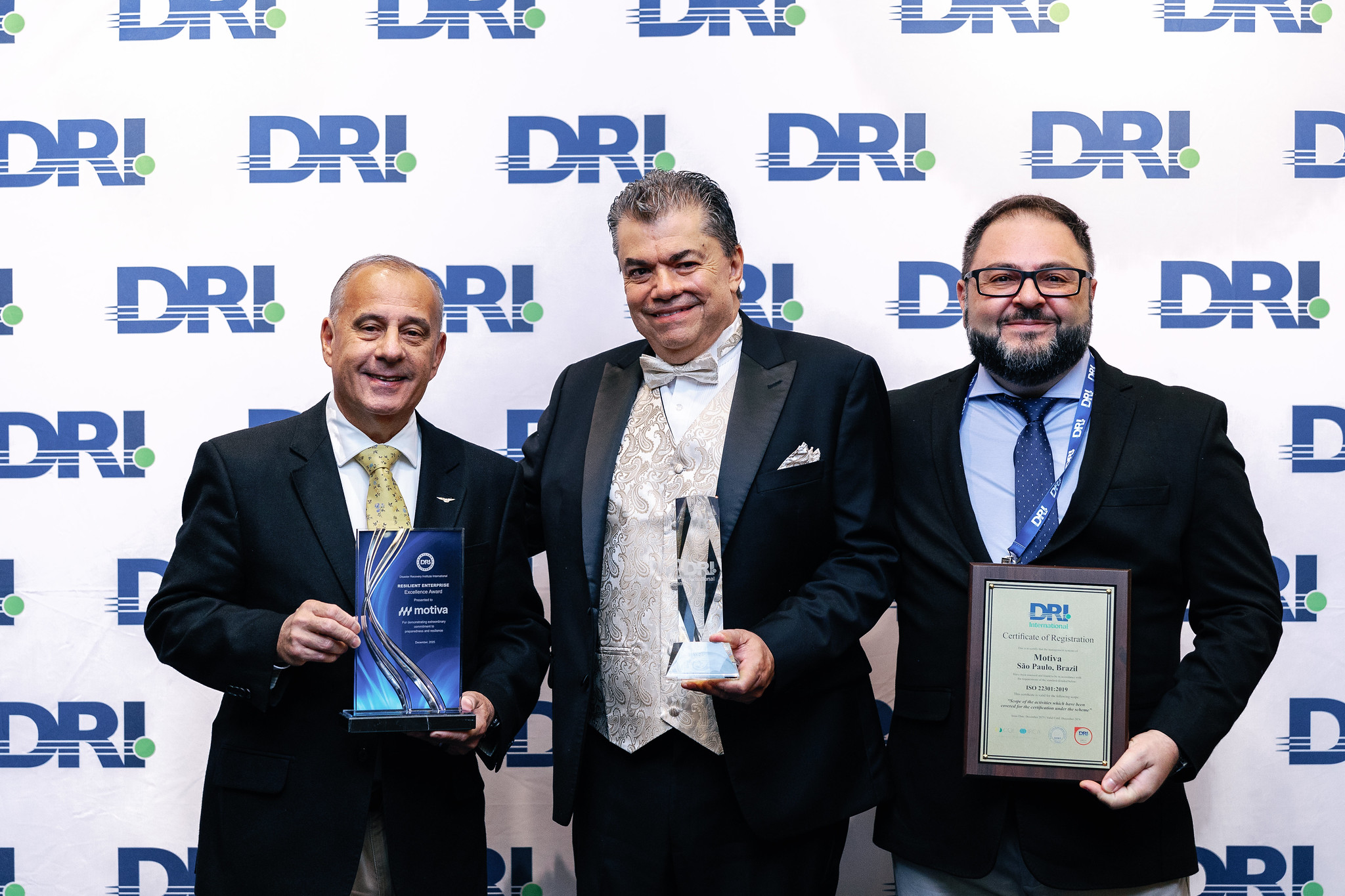
Recognitions granted by DRI International attest to the robustness of the Company’s Crisis Management and Business Continuity Management System
São Paulo, March 10, 2026 – Motiva, Brazil’s largest mobility infrastructure company, has achieved three unprecedented milestones in its corporate resilience strategy. The Company became the first organization in South America to receive the Resilient Enterprise Award, granted by DRI International (Disaster Recovery Institute International), a global leading nonprofit in business continuity and resilience education and certification. The Company also obtained the ISO 22301 certification, the international standard for Business Continuity Management Systems (BCMS), as well as the Resilient Enterprise Assessment Program (REAP) certification, the latter granted by DRI International.
In addition to reinforcing Motiva’s commitment to operational excellence, asset safety, and preparedness, the achievements also attest to the Company’s technical capability to navigate complex operational scenarios, including extreme weather events and operational incidents, ensuring business continuity and the protection of people.
“These achievements represent a historic milestone for Motiva because they consolidate a corporate, integrated vision of enterprise resilience—spanning prevention and response, service continuity and crisis management. The recognitions reflect the robustness and maturity of our Crisis Management and Business Continuity Management System and validate our efforts to adopt global best practices to protect the lives of our customers and employees, safeguard our assets, and ensure the continuity of services that are essential to the Brazilian population and society,” said Miguel Dau, Motiva’s Director of Corporate Security and Enterprise Resilience.
“We are honored to award Motiva the prestigious DRI International Resilient Enterprise award along with the ISO 22301 certification in recognition of Motiva’s commitment to supporting a comprehensive resilience program that encompasses regulatory compliance, business continuity, disaster recovery and crisis management functions.” said Al Berman, President of the DRI Foundation and Treasurer of DRI International. “We also recognize this groundbreaking achievement as the first ever to receive this recognition in South America.”
Miguel Dau, Motiva’s Director of Corporate Security and Enterprise Resilience, was presented with both awards on the evening of February 24th during the Awards of Excellence Gala at DRI’s premier annual conference for business continuity professionals, DRI2026, held at the Hyatt Regency Jacksonville Riverfront in Florida.
Motiva’s Business Continuity Management
To earn these recognitions, Motiva was assessed by DRI International against a set of criteria, including: organizational structure and governance; planning and assessment; testing and maintenance of plans; crisis management and communications; training and awareness; and emergency and incident response plans.
Unlike other Brazilian companies that had previously obtained ISO 22301 certification with a focus limited to specific areas—such as IT and financial systems—Motiva adopted a strategic, holistic approach, covering the organization’s priority risks and promoting end-to-end enterprise resilience across the Company and its business platforms.
As a result of this innovative approach, in addition to ISO 22301 certification, the Company also received the Resilient Enterprise Award, which recognizes organizations that demonstrate a strong commitment to business continuity management disciplines, including emergency management, business continuity, disaster recovery, and crisis management.
DRI International is the oldest and largest nonprofit that helps organizations around the world prepare for and recover from disasters by providing education, accreditation, and thought leadership in business continuity, disaster recovery, cyber resilience, and related fields. Founded in 1988, DRI has certified more than 20,000 resilience professionals in 110+ countries and at 95 percent of Fortune 100 companies.
Established to recognize organizations that have demonstrated extraordinary commitment to preparedness and resiliency, the “Resilient Enterprise” award is DRI’s official “standard of excellence” designation for organizations. All organizations are eligible to apply for the designation which require an extensive evaluation process and strict qualifying protocols in an effort to ensure the appropriate level of knowledge and proficiency of an entity’s business continuity management program. Resilient Enterprise and ISO 22301 certifications may be awarded when the organization’s requirements comply with ISO 22301.
Pioneering climate resilience
Motiva was a pioneer in Brazil’s mobility infrastructure sector when, in 2024, it launched its climate resilience strategy, incorporating climate change as a key variable in its business strategy—significantly influencing the Company’s growth plans and the day-to-day management of its highways, rail, and airport operations.
The climate resilience strategy was structured around two workstreams. The first, more strategic, focused on mapping risks across all assets and estimating the financial costs of impacts caused by climate events, based on the recommendations of the Task Force on Climate-related Financial Disclosures (TCFD), considering climate-event scenarios through 2050.
The second workstream includes the use of short- and medium-term climatological and meteorological information to measure the impacts of these variables on business strategies and asset management. In partnership with MeteoIA, Motiva has access to climatology reports with three- and five-year forecasts. This information is used, for example, to estimate market growth curves, support works planning, inform budgeting processes, and assess new concessions and acquisitions.
To address the challenge of operating assets amid increasing frequency and severity of extreme weather events, Motiva partners with Climatempo, which provides daily reports on weather conditions in the locations where the assets are situated. Through the SMAC tool, the Company monitors a range of climate variables—such as lightning incidence, rainfall volume, and wind speed—as well as wildfire hotspots in the regions where its assets operate.
The data is made available to the Operational Control Centers (OCCs) of its business platforms, which have been adapted to display information in real time on dashboards and large screens to support monitoring and decision-making by managers. Monitoring is complemented by other equipment installed by Motiva at strategic points along its concessions, such as rain gauges and inclinometers.
This information is used to trigger operational protocols that protect the lives of customers and Motiva employees. At RioSP, for example, when rainfall exceeds predefined thresholds, the concessionaire temporarily halts vehicle traffic on the Rio–Santos highway between Ubatuba (São Paulo State) and Rio de Janeiro as a preventive measure against the risk of landslides along the corridor. The same concept has also been applied by ViaSul in the operation of BR-386 in Rio Grande do Sul.
Within this workstream, Motiva has a technical cooperation agreement with Brazil’s National Center for Monitoring and Early Warnings of Natural Disasters (Cemaden) to receive landslide and flood alerts to support decision-making. In return, the Company provides access to its monitoring cameras and sensor data to assist Cemaden in identifying emergencies.
As an outcome of this work, Motiva completed last year the development of approximately 5,000 climate adaptation plans to make its highway, rail, and airport concessions more resilient to extreme climate events. With this initiative, the Company achieved its goal of having 100% of critical assets covered by adaptation plans by the end of 2025, strengthening its sector leadership in this agenda.
Based on a detailed assessment of more than 4,000 kilometers of highways managed by Motiva, rail stretches between its 120 train, metro, and LRT stations, and the airport zones of its 17 terminals in Brazil, Motiva identified the concessions that are most critical in terms of climate adaptation, the main physical and transition risks for each business platform, and produced initial estimates of the financial impact of climate events, considering infrastructure damage, operational disruption, and works delays.
Planned measures to mitigate climate threats across each platform include: adapting rail infrastructure to withstand high temperatures; strengthening drainage systems to mitigate flooding; monitoring the physical properties of assets during heatwaves; upgrading airports to cope with heavy rainfall; adapting construction standards; increasing the frequency of drainage maintenance; monitoring soil and subgrade conditions; and incorporating green areas within airport zones. These actions were divided into structural and non-structural measures and categorized as preventive, mitigation, and emergency response actions.
About Motiva | Brazil’s largest mobility infrastructure company, Motiva operates across the Highways, Rail, and Airports platforms. It has 37 assets in 13 Brazilian states and 16,000 employees. The Company is responsible for the management and maintenance of 4,475 kilometers of highways, delivering around 3,600 assistance services daily. In Rail, through the management of metros, trains, and LRT systems, Motiva transports 750 million passengers annually. In Airports, with 16 units in Brazil and three abroad, it serves approximately 45 million customers annually. Motiva was the first company to go public on B3’s Novo Mercado and has been part of B3’s sustainability indices for 14 consecutive years.

